The night before an exam has a particular feeling. Your notes are spread out, your mind is full, and somehow also completely empty. You read the same paragraph three times and retain none of it. You wonder if you studied the right things, if everyone else feels this prepared, and if one bad morning could undo weeks of work. I remember walking to my own exam hall with that same weight — not the books in my bag, but everything I had not quite finished. If that sounds familiar, take a breath. You are not behind because you are nervous. Nervousness before an exam is not a sign of failure; it is a sign that something matters to you, and that you have worked for it.
If you are reading this the night before an exam, or in the car on the way there, or on your phone in a corridor while everyone else looks strangely confident, this is for you. A prayer before an exam is not a trick for getting a grade you did not study for. It will not put answers in your head that you never learned. What it can do, honestly and practically, is settle your breathing, clear the noise in your head, help you use what you actually know, and keep one test from deciding how you see yourself. That is no small thing on a morning when your stomach is tight and your thoughts are racing.
Let us be straight about something first. Some students pray as if they are negotiating. If I pray hard enough, maybe the hard questions will not appear. If I promise to be better, maybe the result will be better. That kind of prayer leaves you more anxious, not less, because now you are worried about whether you prayed correctly as well as whether you studied enough. Prayer works differently. You bring God the real situation — the preparation you did, the preparation you did not do, the fear, the hope, the pressure from home — and you ask for help with the next step, not control over the outcome. That shift, from bargaining to trusting, is where peace usually starts.
What Scripture Actually Promises Before an Exam
Scripture does not promise that every faithful student will pass every exam. Anyone who tells you otherwise is selling something, not quoting the Bible. What it does promise is presence, wisdom for those who ask, and a peace that does not depend on everything going perfectly. That distinction matters, because if you walk in expecting a guaranteed grade, a difficult paper will feel like God let you down. If you walk in expecting God to be with you in a difficult paper, you can still think, still breathe, still answer the next question.
“In nothing be anxious, but in everything, by prayer and petition with thanksgiving, let your requests be made known to God. And the peace of God, which surpasses all understanding, will guard your hearts and your thoughts in Christ Jesus.” — Philippians 4:6-7 (WEB) Read the passage in the World English Bible on BibleGateway.
Notice that peace here is described as a guard — something that stands watch over your heart and your thoughts. That is a helpful picture for exam day. You do not have to manufacture peace by trying harder to relax, which usually has the opposite effect. You ask for it, you receive it as a gift, and you let it stand guard while you work through the questions one by one. If a question frightens you, peace does not remove the question; it keeps fear from answering it for you.
Read that slowly, because the order is the point. First, bring everything — not just the polished, spiritual-sounding worries, but the actual ones. I am afraid I will blank. I am afraid my parents will be disappointed. I am afraid I chose the wrong course. Then, with thanksgiving: not thanking God for a result you do not have yet, but remembering what is still true. You are still loved. You still have a future beyond this paper. You learned something this term, even if you cannot recall all of it right now. Thanksgiving does not deny anxiety. It gives anxiety less room to run the whole show.
And then there is wisdom. James writes that if anyone lacks wisdom, they should ask God, who gives generously. That is a different prayer from “give me the answers.” Wisdom on exam day looks like knowing which question to start with, noticing that you misread a word, leaving a question you cannot solve instead of losing twenty minutes to it, and writing clearly rather than writing everything you know in a panic. Wisdom is practical. It shows up in small decisions, minute by minute, and those small decisions add up to marks.
“But if any of you lacks wisdom, let him ask of God, who gives to all liberally and without reproach, and it will be given to him.” — James 1:5 (WEB)
If your mind is already spinning, it can help to pray one verse rather than a long speech. When anxiety rises, many students find that a short, repeated prayer steadies them more than a long one they cannot remember under pressure. Try this: breathe in, and think, “Lord, You are with me.” Breathe out, and think, “I will do the next question.” That is not a magic formula. It is a way of giving your mind something true to hold while your body calms down.
Not Every Exam Is the Same — And Your Prayer Should Not Pretend Otherwise
Here is something most exam prayers miss entirely: a prayer before an exam sounds different depending on what kind of exam it is. A multiple-choice test, an essay exam, an oral exam, a practical exam, a driving theory test, a nursing license exam, a final at university — these are not the same experience, and the pressures are not the same either.
For a multiple-choice exam, the danger is rushing, second-guessing, and changing a right answer to a wrong one in the last five minutes. Pray for patience: read every option, eliminate what is clearly wrong, trust your first careful answer unless you have a real reason to change it. For an essay exam, the danger is the opposite — writing everything, planning nothing, and running out of time halfway through your best point. Pray for structure: five minutes planning, a clear argument, evidence you actually remember, and a conclusion even if it is short.
An oral exam or a presentation feels exposed in a different way. People are watching. Your voice shakes. You forget a word you knew perfectly in your room. Pray for steadiness, not perfection: speak slowly, pause instead of filling every silence with “um,” and remember that examiners are usually listening for understanding, not flawless performance. A practical exam — nursing, teaching, a lab, a trade test — adds the pressure of doing something with your hands while someone watches. Pray for calm hands and a clear sequence: do the steps in order, say what you are doing if that helps, and do not let one small mistake unravel the whole task.
And then there is the online exam, which barely existed in older prayer guides and now shapes so many students’ lives. You are at home, but you are not relaxed. The proctoring software is watching. Your internet might drop. A family member might walk in. Your laptop might update at the worst moment. Pray for the practical things too: a charged device, a stable connection, a quiet room, a backup plan if the page freezes. Test your login the day before. Keep water nearby. Tell the people you live with, clearly and kindly, that you cannot be interrupted between certain hours. God cares about those details because you do, and because a dropped connection is not a spiritual failure — it is a technical problem that needs a calm response, not panic.
If this is a retake, your prayer carries something extra. You have already sat this exam once, and it did not go the way you hoped. That memory follows you into the room. You might hear a voice saying, “You failed before, you will fail again.” Name that voice for what it is: a memory, not a prediction. You are not the same student you were last time. You have seen the paper format, you know where you lost marks, and you have had time to prepare differently. Pray specifically about the retake: for freedom from shame, for focus on this paper rather than the last one, and for the courage to try again without apologizing for needing a second chance. Plenty of good careers, good nurses, good teachers, good engineers, started with a retake.
The Week Before: Studying in a Way Prayer Can Actually Support

Prayer and preparation belong together, and preparation that actually works looks less heroic than most students think. It is not twelve hours of rereading notes with a highlighter. Rereading feels safe. It feels like learning. Too often, it is just recognition — you recognize the words, so you assume you know them, and then the exam asks you to produce them from nothing and they are gone.
What works better is embarrassingly simple and slightly uncomfortable. Close the book. Try to write down what you remember. Check what you missed. Do it again tomorrow. That is active recall, and it feels harder precisely because it is working. Mix topics rather than studying one chapter for six hours straight. Do past papers under timed conditions, not just reading model answers and thinking, “Yes, I would have said that.” You probably would not have, under time pressure, and finding that out at home is far better than finding it out in the hall.
Break your study into shorter blocks with real breaks. Fifty minutes of focused work, ten minutes away from the desk, is worth more than three foggy hours staring at a screen. Sleep is part of studying, not a reward for finishing it. Your brain consolidates memory while you sleep. An all-nighter might feel dedicated, but it usually costs you recall, patience, and clear thinking the next morning — exactly the things you need most. Eat properly. Drink water. Go for a short walk. These are not distractions from preparation. They are preparation, for a body and mind that have to perform.
It also helps to decide, honestly, what you will not cover. No student revises everything perfectly. Choose the topics most likely to appear, the ones worth the most marks, and the ones you almost understand — those are often the best return on your remaining time. Pray about that choice, too, if it helps: “Lord, help me use these last hours wisely, and help me let go of what I cannot cover.” Letting go is not giving up. It is choosing focus over frantic, scattered panic.
If fear is making it hard to start at all — you open your notes, feel overwhelmed, and close them again — try a smaller start. One page. One set of flashcards. One past question. Tell yourself you only have to do ten minutes. Often, starting is the hardest part, and momentum does the rest. If the fear does not lift, if your chest is tight for days, if you cannot sleep or eat properly, talk to someone: a teacher, a tutor, a parent, a counselor. That is not a lack of faith. That is wisdom, and it is the kind of help prayer often points us toward.
The Night Before and the Morning Of

The night before an exam is where good intentions usually fall apart. You tell yourself you will do one more chapter, then another, then you are still awake at 2 a.m. with a headache and a phone full of revision videos. Stop earlier than feels comfortable. Review your weakest topics first, while your mind is freshest, then do a short recall test, then pack your bag. Pens, identification, water, any allowed calculator or materials, the route or the login details. Lay out clothes. Charge everything. Set two alarms if you sleep heavily.
Then do something that is not revision. A walk, a shower, a meal with family, a short prayer, a conversation about anything except the exam. If your mind races in bed, do not rehearse worst cases until dawn. Try a prayer for peace before sleep, hand the day over, and let your body rest. If a thought keeps returning — “I forgot to revise that topic” — write it on a piece of paper, put it by your bag, and deal with it in the morning if there is time. Writing it down tells your brain it does not have to hold it all night.
In the morning, eat something real, even if your stomach says no. Arrive early enough that you are not running. Avoid, if you can, the panic circle outside the hall: the group comparing notes, discovering topics nobody else studied, and raising everyone’s heart rate before the paper even starts. A brief prayer before you leave home, and one quiet sentence before you open the paper — “Lord, help me think clearly” — is enough. You have prepared. Now trust the preparation, and trust God with the rest.
For an online exam, add a ten-minute tech check. Restart your device if it is slow. Close extra tabs. Put your phone on silent and out of reach, unless the exam requires it. Have your student ID ready. If the platform allows a practice login or a system check, do it the day before, not five minutes before the start. If something goes wrong during the exam, note the time, take a screenshot if allowed, and contact your invigilator or institution as soon as you can. Stay calm, keep working if the platform allows it, and do not assume a glitch means you have failed.
Inside the Room: A Plan for the Paper Itself
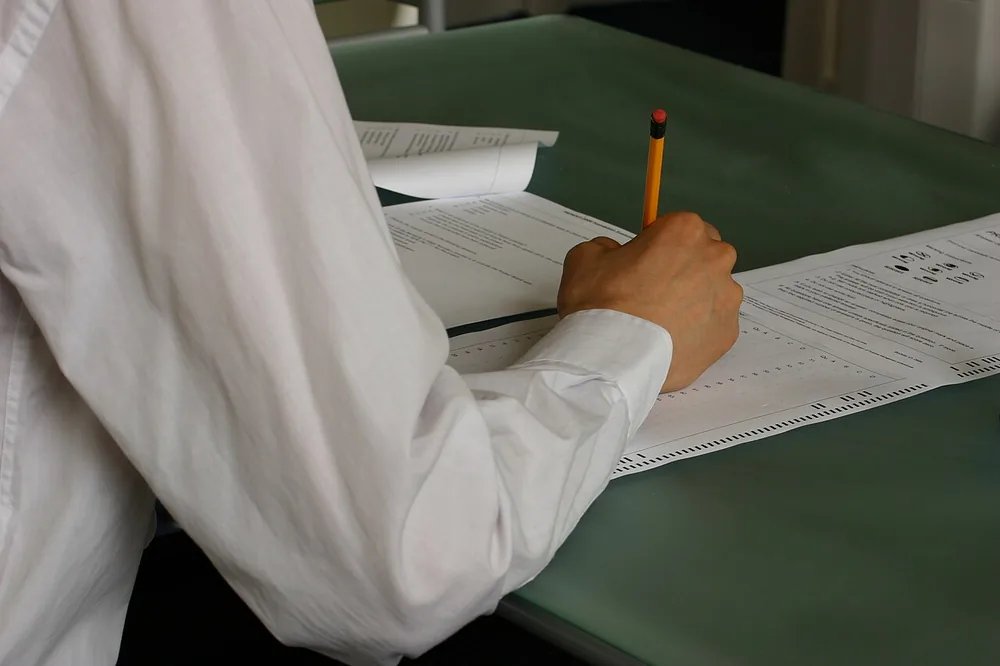
When the paper lands on your desk, do not start writing immediately. Take sixty seconds. Breathe. Read the instructions. Count the questions. Work out, roughly, how many minutes each question deserves. Write those times in the margin if it helps. This is not wasted time. It is the difference between finishing calmly and discovering, with twenty minutes left, that you still have half the paper to do.
Start with a question you can answer. Confidence early changes everything. It settles your hand, it reminds you that you do know something, and it earns marks while your mind warms up. If a question frightens you, do not wrestle it to the ground immediately. Mark it, move on, and return with fresh confidence. Marks earned elsewhere rebuild the calm that recall needs.
When you go blank — and many strong students do, at least once — put your pen down. Breathe slowly for thirty seconds. Read the question again, slowly, underlining the key words. Ask yourself what topic it belongs to, and what you remember about that topic in general, even if the specific answer has not surfaced yet. Often, writing down anything related — a definition, a formula, an example — loosens the rest. If it still does not come, move on. A blank mind is usually a panicked mind, not an empty one, and panic eases when you give it a smaller, doable task.
Watch out for the comparison trap. Someone finishes early. Someone is writing furiously while you are still thinking. Someone sighs loudly. None of that tells you how well they are doing. The early finisher might have skipped questions. The furious writer might be writing beautifully and incorrectly. Keep your eyes on your own paper, in every sense. Your pace is your pace, and your paper is the only one you can control.
Be honest, even when honesty costs marks in the short term. Do not copy, do not glance at a neighbor’s paper, do not use a phone or notes you were told not to use. Apart from the obvious reasons, cheating adds a second anxiety to the exam: the fear of being caught, on top of the fear of failing. An honest result, even a disappointing one, is something you can learn from and build on. A dishonest one follows you, and it teaches you to fear the next exam even more. Pray for integrity when the temptation is real, not just when it is easy: “Lord, help me do this honestly, even if it means a lower mark.”
Use the last ten minutes well. Reread questions to check you answered what was actually asked, not what you assumed was asked. Check names, dates, units, and calculations. If you changed an answer, make sure you had a reason, not just a nervous feeling. Then stop. Hand it in, or submit it, and walk away. The exam is over. Replaying it for hours will not change a single mark.
When the Exams Keep Coming: Praying Through a Whole Exam Season
Most exam prayers imagine a single paper, but many students face a week of them, and that changes the prayer. The danger in an exam season is not one bad morning. It is peaking on day one and running empty by day three, or carrying yesterday’s paper into today’s room and answering today’s questions with yesterday’s disappointment still ringing in your ears. Pace yourself the way you would pace a run: yesterday’s paper is finished, whether it went well or badly, and today’s paper deserves a mind that is present for it, not one still grading the last one.
Between papers, do three small things. First, rest on purpose — a walk, a meal, an early night — rather than cramming until the next paper in a panic, because a tired mind recalls less, not more. Second, prepare only for the next paper, not for all of them at once; the whole season is too big to hold in one evening. Third, close each day with a short release: “Lord, that paper is done. I leave its result with You, and I ask for fresh focus for tomorrow.” If one paper went badly, grieve it briefly and honestly, then let it go; one paper is not the season, and the season is not your life.
For a whole exam season, pray: “Lord, give me stamina, not just a good first day. Help me sleep between papers, study what is next without dreading what is last, and walk into each room as if it were the only exam that mattered that day — because for that day, it is. Amen.”
Short Prayers for Each Moment

Long prayers are good at home. In the exam room, you need short ones. Keep these in your pocket, literally or mentally, and use whichever fits the moment.
Before you open the paper: “Lord, calm my mind. Help me use what I have learned. Be with me in this room.” When you go blank: “Lord, help me breathe, and help me remember one thing at a time.” When a question is hard: “Lord, give me wisdom for this question, and grace to move on if I cannot solve it now.” When time is running short: “Lord, help me focus on what I can still do well, not on what I have missed.” When you finish: “Lord, thank You that this is done. I trust You with the result.” Each of these takes seconds. Each breaks the spiral of panic and returns you to the next question, which is the only question you can answer right now.
If you are a parent, a grandparent, a spouse, or a friend praying for a student, your prayer matters more than you might think. Students often say that knowing someone else is praying steadies them, even if they cannot explain why. Pray specifically: for sleep the night before, for calm in the room, for recall, for honesty, for kindness toward themselves whatever the result. And when you talk to them, watch your words. “Just do your best” lands very differently from “You had better pass this.” Pressure from home can turn a hard exam into an unbearable one. Your calm is part of their calm.
A Prayer Before an Exam
Heavenly Father, thank You for the opportunity to learn, for the teachers who taught me, and for the work I have been able to do to prepare for this exam. You know what I studied well, what I still find difficult, and what I did not get to at all. I place this exam, and my hopes for it, in Your hands now.
Lord, calm my mind and steady my heart. Slow my breathing. Help me read each question carefully, remember what I have learned, and think clearly under pressure. Give me wisdom to manage my time, to start where I am strong, to leave a hard question and return to it, and to write honestly and clearly. When I go blank, remind me to breathe and to take one small step at a time. When I compare myself to others, remind me to keep my eyes on my own paper.
Give me grace toward myself when a question is hard, and integrity when honesty is costly. Be with the other students in this room, with those marking the papers, and with my family waiting at home. Give us all fairness, patience, and a clear mind today.
Thank You that my worth is not measured by this score. Whatever the result, help me learn from it, celebrate honest effort, and trust You with what comes next — a pass, a retake, a changed plan, or a door I had not expected. I trust You, Lord, with this exam and with my future. In Jesus’ name, Amen.
After the exam, pray again, and not only if it went well. Thank God that it is over. Be honest about how it felt. Resist the urge to dissect every answer with friends for hours, comparing who wrote what and convincing yourself you failed because someone else remembered a detail you missed. That post-exam autopsy rarely changes the result and usually only feeds anxiety. Rest. Eat. Do something enjoyable. Let your mind recover before you start worrying about the next paper.
When the Result Comes: Good News, Bad News, and Everything Between

Results day deserves its own prayer, because it brings its own temptations. If you did well, celebrate — genuinely, and without apology. Thank God, thank the people who helped you, and enjoy it. Just watch for the quiet trap of a good result: believing that your worth went up with your grade, and that the next exam must be even better or you have failed. A good result is a gift, not a new identity. Stay humble, stay kind to classmates who did not do as well, and remember that you still need the same grace for the next challenge.
If the result disappoints, grieve it honestly. Do not pretend it does not hurt, and do not let anyone tell you it should not. It is okay to be upset, to cry, to need a day to sit with it. Then, when you are ready, ask practical questions rather than only painful ones. Where did I lose marks? Was it knowledge, timing, exam technique, or preparation? Can I see the paper or get feedback? Is there a retake, a resit, an appeal, or a different route to the same goal? Talk to a teacher or tutor before you decide anything permanent. A disappointing grade is information, not a verdict on your life.
Telling your parents or family can feel harder than the exam itself. Be honest and specific: what happened, what you learned, and what your plan is. Most parents, once the initial disappointment passes, would rather hear a plan than an excuse. If your family puts heavy pressure on results, it can help to say that plainly, kindly: “I know this matters to you, and it matters to me too. What I need right now is help with the next step, not only disappointment about the last one.” And if you are the parent receiving disappointing news, remember what this student needs most in that moment: not a lecture, but a steady voice that says their future is bigger than one result.
For ongoing peace while you wait, a prayer for hope can steady you between the exam and the result, and when the next challenge comes, asking God for guidance about courses, careers, and next steps is a prayer worth praying slowly, not hurriedly. Your education is a long road. One exam is a single step on it, and God walks the whole road with you, not just the exam hall.
Frequently Asked Questions
Can I pray during the exam itself?
Yes. A silent, one-sentence prayer takes seconds and breaks the spiral of panic. You do not need to close your eyes for a long time or stop working. “Lord, help me think clearly” is enough, and it is genuinely helpful for regaining focus in the room.
What if I did not study enough?
Be honest about that, pray anyway, and do your best with the time left. God is not only for well-prepared students. Answer what you can, manage your time, and afterwards make a different plan for next time — earlier starts, shorter focused sessions, past papers, and asking for help sooner rather than later.
What should I do if I go blank in the middle of an exam?
Put your pen down, breathe slowly, and reread the question. Write down anything related you do remember, even a definition or an example. If it still does not come, mark the question, move to one you can answer, and return later. Blanking is usually temporary, and calm restores recall far better than panic does.
Does God care about exam results?
God cares about you, and therefore He cares about things that matter to you, including exams. But His care is not measured by grades alone. He cares about your character, your diligence, your honesty, and your peace, in success and in disappointment alike. Trusting Him means trusting Him with both the paper and the person holding the pen.
How do I handle an online or proctored exam?
Check your technology the day before, charge your device, close extra tabs, and tell the people you live with not to interrupt you. If something goes wrong, note the time, keep calm, and contact your invigilator or institution as soon as you can. A technical problem is not a personal failure, and most institutions have a process for it.
What if I fail or need a retake?
A retake is not the end of your story. Get feedback, find out where you lost marks, and make a specific plan for next time rather than simply studying harder in the same way. Many successful professionals retook an exam. Ask for help early, and do not carry shame into the next attempt — carry what you learned instead.
Can someone else pray for me before my exam?
Yes, and it helps more than students often admit. Ask a parent, friend, or church community to pray for calm, recall, and peace, and for grace whatever the result. If you are praying for a student, pray specifically, and speak to them with encouragement rather than pressure in the days before the exam.
Go into your exam prepared, prayerful, and at peace. Do your best, answer honestly, and leave the result in God’s hands. If hope feels thin while you wait, a prayer for hope can steady you until the result arrives. Whatever score comes back, you are more than a mark on a page — and the God who gave you a mind to learn is with you in the room. And when the exam season ends and graduation day arrives, a graduation prayer can carry that same peace into the next chapter of your life.

The Praytivo Editorial Team writes and curates Bible-based prayers, devotionals, and verse reflections to help you pray with confidence every day.